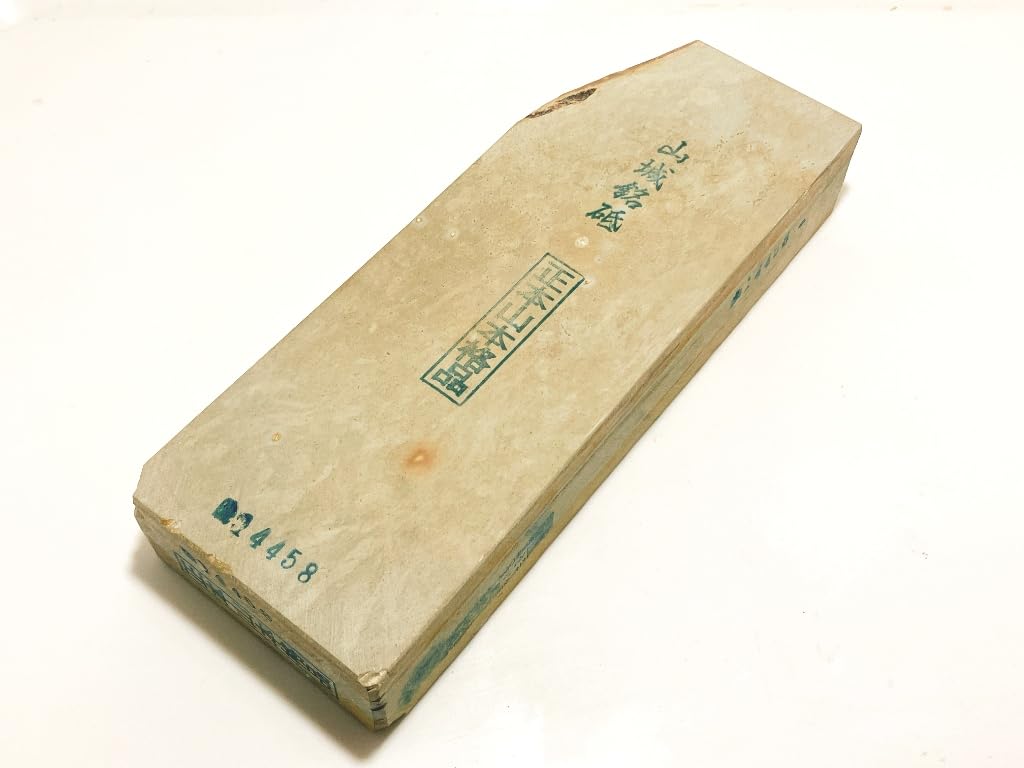
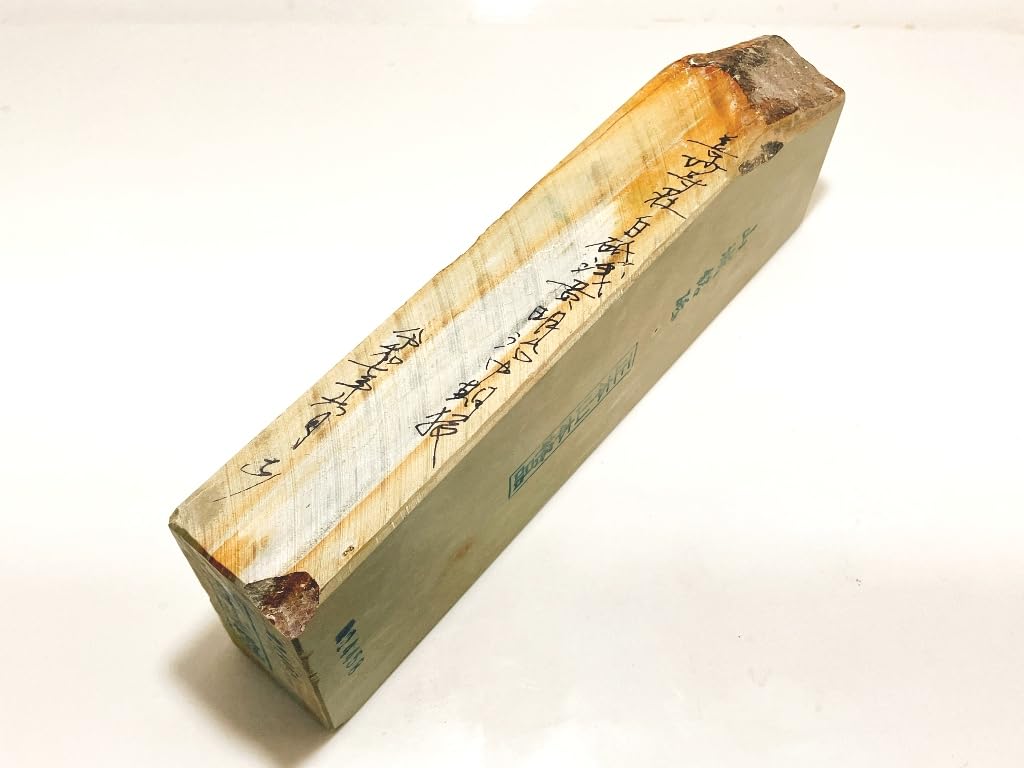
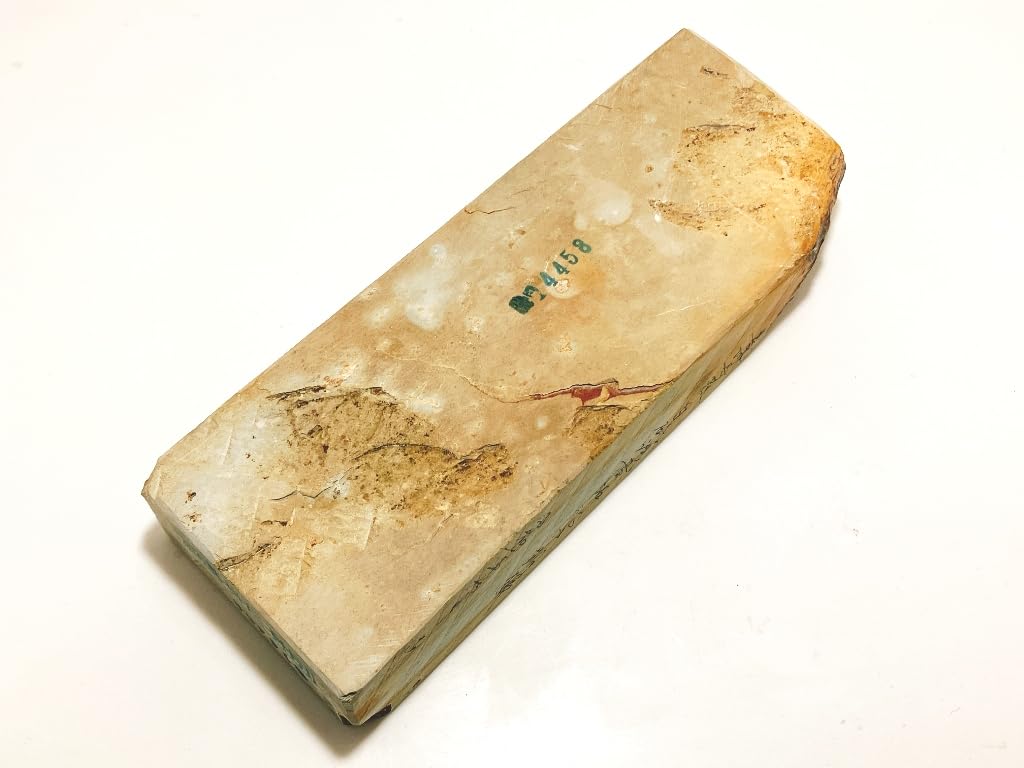
76 x 205 x 37 mm, 1,424g, suitable for hard tools.
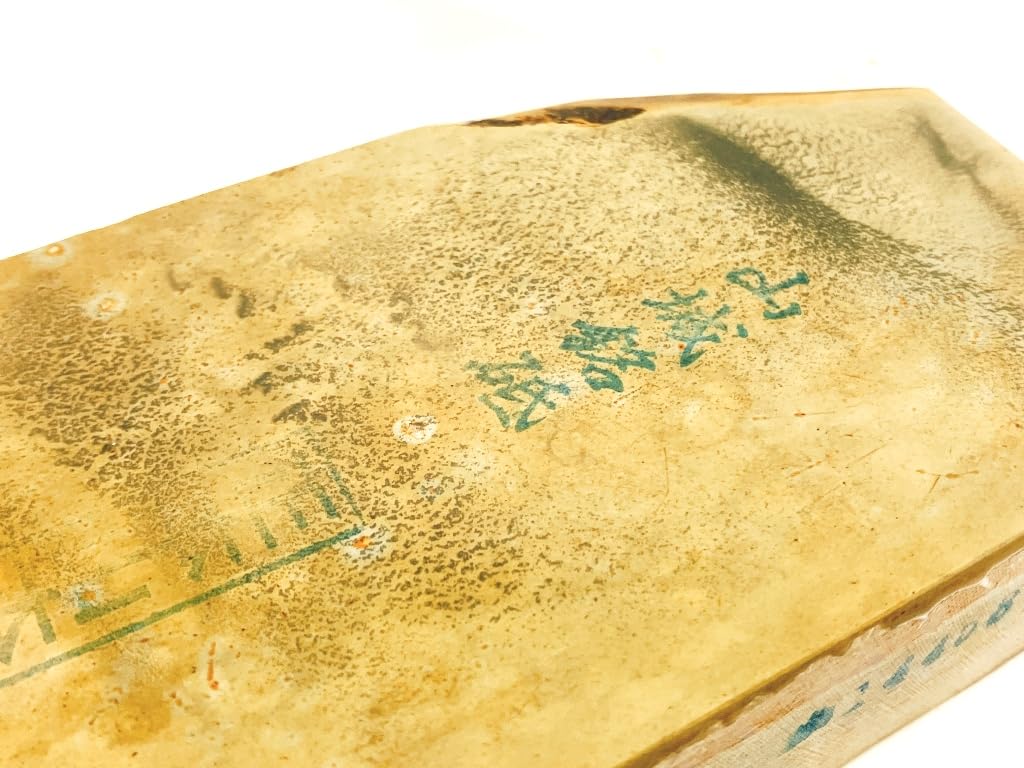
A beautiful whetstone with a light green, pearlescent finish. During the widening of a national highway in the mid-Meiji period, when the Takao Zenmyo-ji estate was removed, the raw stone was reforged and re-processed to create this product. Because it was originally used as filler for stone walls, it is completely free of freezing. The mica content is fully elevated, and it can never be returned to being just a cut or polished stone.
Siliceous slate from Umegahata, Ukyo-ku, Kyoto City, Yamashiro Province. Grit size #6,000 to 24,000. Harder stones require more practice, but the probability of achieving a finer finish increases. Due to the rounded bottom and continuous grooves, it maintains its sharpness for about 70% of its lifespan, and with artificial stone grit ratios, it is less likely to produce a dull, mirror-like finish, making it easier to bring out contrasts derived from the weld lines, material, and carbon content differences.
The darker the rock, the harder and finer the stone tends to be. Since hardness reduces the sharpness, sharpening should be done by applying a nagura (a type of stone used for sharpening) as needed, depending on the purpose and skill level.
This natural whetstone, originating from Yamashiro Province (present-day Kyoto City), has its roots in the invention of the Japanese sword.
With a history spanning nearly 900 years since the late Heian period, it is known as the finest and most prestigious whetstone among slate-based whetstones.
It was the most important military resource in the long-lasting era of swords, and was under the control of the shogunate from the Kamakura period to the end of the Edo period.
From the perspective of values up until the early modern period, it had a strong character as a material for arsenals, and in modern terms, it could be called a uranium mine essential for nuclear weapons, requiring strict control.
Iyo Province-produced igneous rocks are believed to have been circulating in the Seto Inland Sea region since the Kofun period, and are renowned as the world's oldest and largest-scale igneous rock-based polishing industry, with a history spanning over 1,500 years.
Our country's resources for master whetstones possess the power to completely transform our nation and people.
The scarcity of iron ore, coupled with the unique iron sand metallurgy process resulting in significantly lower yields, and its location as a remote island in the Far East, which served as the final destination for the introduction of iron, presented fatal conditions for establishing an iron age civilization, much like losing one's limbs.
Considering our history and tradition, it is clear that our country's finest whetstones are consumables that allow us to process iron products to be harder and tougher, just as we wish.
Despite its unsuitable location for construction, it became the world's oldest and largest wooden structure.
Despite being a latecomer from a remote region, by the Middle Ages they had already achieved world-leading inventions in iron products, which allowed the sword to continue for nearly 700 years.
Since most of recorded history belongs to the Iron Age, iron tools became an extension of our hands and feet, and were the very means by which we worked in manufacturing.
The fact that Japan is known today as a nation of manufacturing power is a natural progression, given that it has been proven that it was already capable of producing the world's strongest iron products and tools around 1,300 years ago, during the construction of Horyu-ji Temple in ancient Asuka.
It's true that when starting out in the iron industry, I overcame even the adversity of losing my limbs.
The irreplaceable, rare, and uniquely authentic whetstone resources provided support because, during the development of steel, the limiting factor of whether or not it could be sharpened was eliminated by the exceptional performance of the whetstones.
If we measure our country's various resources using modern values, it would still be considered a resource-rich nation even though 70% of its land is covered in forests.
However, precisely because the Japanese archipelago is formed by five tectonic plates, it has been able to withstand numerous natural disasters, and in return, it has been permitted to extract whetstones in various regions, albeit in varying quantities and qualities.
Our hearts, having accepted and embraced being governed by a majestic, mountainous natural environment that possesses both harshness and abundance (the carrot and the stick), have gradually learned patience, cooperation, and compromise. Perhaps this led us to foresee the existence of nature worship and the myriad gods (various resources and blessings) that weave together daily expressions of gratitude, and ultimately to the foundation of the Shinto spirit.
This is what will pass down Japan's greatest strengths and attractions, which are not limited to material happiness, but are relatively tolerant of different cultures and religions, and capable of repeated absorption and integration.


 מוצר מיפן


 החזר על אי אספקה