Worth knowing:
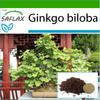
The Maidenhair Tree is a bridge-like plant since it combines attributes of conifer with those of a broad-leaved tree and its origins date back to the age of the dinosaurs. It grows in a remarkably wide projecting form with horizontally sprouting branches. In many parts of Asia it is cultivated and worshipped as a temple plant.
Natural Location:
Only in China the Maidenhair Tree survived, as the only plant of his kind, the ice age. Around 1730 it also spread to Europe.
Cultivation:
Seed propagation indoors is possible throughout the year. To increase its germinability, you can slightly roughen the seed with a soft file or a piece of sandpaper and place it for about 12 hours in warm water for priming. Then, press the seeds into moist potting compost, put just a little compost earth on top and cover the seed container with clear film to prevent the earth from drying out. Don’t forget to make some holes in the clear film and take it every second or third day completely off for about 2 hours. That way you avoid mold formation on your potting compost. Place the seed container somewhere bright and warm with a temperature between 20°C and 25°C and keep the earth moist, but not wet. The first seedlings will come up after three to four weeks.
Place:
Keep your Maidenhair Tree in a sunny place, but protect especially the seedlings and young plants from direct strong sunlight.
Care:
Water your Ginkgo regularly and sufficiently. Especially young plants react otherwise with yellow and limp leaves. From April until September you may give special fluid fertilizer for bonsai plants every two weeks.
During the winter:
During winter, you can keep the plant rather dry since it doesn't require a lot watering after loosing its foliage. It is best be kept in a sheltered and cool room without frost - the roots of the Maidenhair Tree cannot tolerate strong frosts.
Picture credits:
- © © Cephas - CC-BY-SA-3.0 - http://creativecommons.org/licenses/by-sa/3.0
- © Frank Laue - © Saflax - http://www.saflax.de/copyright
- © Frank Laue - © Saflax - http://www.saflax.de/copyright
- © Cephas - CC-BY-SA-3.0 - http://creativecommons.org/licenses/by-sa/3.0
- © - -
- © - -
- © - -
- © - -
- © - -



 Prece no Vācijas


 Nedēļot atgriešanu